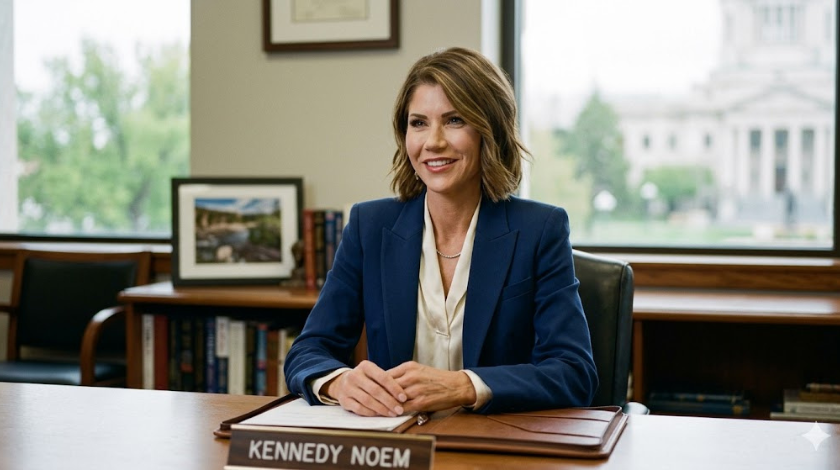
Kennedy Noem: Life in the Spotlight as Kristi Noem’s Daughter
Growing up as the child of a politician is not easy. I have watched many political families over the years, and one thing always stands out: the children often face challenges that most people never see. They live in a strange world where their family name opens doors, but it also invites criticism from strangers who feel entitled to judge them. Kennedy Noem knows this reality better than most people her age. As the middle daughter of Kristi Noem, who now serves as the United States Secretary of Homeland Security, Kennedy has spent most of her life connected to politics in some way. But her story is not just about being a politician’s daughter. It is a story about injuries that ended athletic dreams, about finding new paths when old ones close, and about building a family. At the same time, the world watches and sometimes criticizes everything you do.
Early Years on a South Dakota Farm
Kennedy Noem was born on February 24, 1997, in South Dakota. She grew up in a family that valued hard work, faith, and public service. Her parents, Kristi and Bryon Noem, raised their three children—Kassidy, Kennedy, and Booker—on a farm where everyone was expected to pitch in and help. This was not a childhood of privilege, as some might imagine when they hear about political families. The Noems lived in rural South Dakota, and their kids learned early what it meant to work with their hands and take responsibility for their actions.
I think about what it must have been like for Kennedy as a young girl, watching her mother run for Congress in 2010. Kristi Noem was not just any candidate; she was a Republican running in a competitive race against an incumbent Democrat. Kennedy was only thirteen years old at the time, old enough to understand that her mother was doing something important but probably too young to fully grasp how much their lives were about to change. The family even appeared together in campaign commercials, which meant Kennedy was already getting a taste of public life before she could drive a car.
When Basketball Dreams Came Crashing Down
If you had met Kennedy Noem during her high school years, you would have probably described her first and foremost as an athlete. She played basketball at Hamlin High School, and by all accounts, she was passionate about the sport. Sports can teach young people so many valuable lessons about teamwork, discipline, and handling defeat. For Kennedy, basketball was more than just a game; it was central to her identity and plans.
But sometimes life throws curveballs that change everything in an instant. During her sophomore year of high school, Kennedy took a last-second shot in a basketball game. Another player hit her from behind, and the collision caused a serious fracture in her back. I cannot imagine the pain she must have felt, both physical and emotional. One moment you are doing what you love, and the next moment you are facing months of recovery and uncertainty about whether you will ever play again.
The injury was severe enough that Kennedy needed surgery. Doctors put a screw in her L4 vertebrae and used a hook to connect her L4 and L5 vertebrae, fusing that area. She spent four days in the hospital and then several more weeks in a hospital bed set up in the family’s living room. For a girl who rarely stopped moving, being limited to months of no activity must have felt like torture. Her mother wrote about this period in a 2015 op-ed, describing how difficult it was to watch her daughter go through such a challenging recovery.
This was not Kennedy’s first serious injury either. During her first year, she had already suffered a traumatic dental injury when someone landed on her head during a game, knocking out two front teeth and chipping two others. She went through crowns, temporary implants, and eventually permanent implants. Most people would have quit after one major injury, let alone two. But Kennedy kept coming back to basketball because she loved it that much.
Eventually, though, her body could not take it anymore. After her first year of college basketball at the University of Sioux Falls, her doctor gave her the news every athlete dreads: keep playing, and you risk serious long-term damage. Kennedy had to make an impossible choice between the sport she loved and her future health. She chose her health, but I am sure it broke her heart to walk away from something that had defined her for so many years.
Finding a New Path in Politics
Sometimes the worst moments in our lives lead us to better things we never expected. Kennedy has described her back injury as “a blessing in disguise,” and I understand what she means. If she had continued playing basketball, she would have been in her senior year at USF, focused entirely on her sport. Instead, the injury forced her to reconsider her future, and she discovered an interest in political science that she might never have explored otherwise.
She transferred to South Dakota State University to pursue a degree in political science. The transfer meant losing some credits that did not transfer, which complicated her plans to graduate in three years. But Kennedy was determined. She loaded up on courses and took part-time jobs at restaurants and seed companies to help pay for her education. Her parents helped when they could, but Kennedy and her sister Kassidy were expected to bear the main burden of their college costs. This is something I respect about the Noem family: despite their political prominence, they expected their children to work for what they wanted.
Kennedy did not just focus on classes. She sought out internships that would give her real experience in the political world. She spent time in Washington, D.C., interning with the majority leader of the U.S. House of Representatives and with the House Government Reform and Oversight Committee. Back in South Dakota, she interned during the state Legislature, working with experienced professionals who could teach her how the system actually works. These experiences gave her a foundation that would prove valuable when her mother ran for governor.
When Kristi Noem won the 2018 gubernatorial election, Kennedy joined her transition team. This was a natural fit: Kennedy understood her mother’s vision, she had the educational background, and she had practical experience from her internships. Matt McCaulley, chairman of the transition team, described Kennedy as “smart” with a “strong work ethic,” calling her a good listener with good judgment. These are qualities that matter in politics, perhaps even more than connections or name recognition.
In December 2018, Kennedy officially joined the governor’s office as a policy analyst while still finishing her undergraduate degree at SDSU. She was twenty-one years old and stepping into a role that would put her under immediate scrutiny. Some people accused her of benefiting from nepotism, suggesting she only got the job because her mother was the governor. An anti-nepotism bill was even introduced in the legislature, though it ultimately failed to pass.
Kennedy was aware of the criticism from the start. In interviews, she acknowledged that people would doubt her qualifications because of her family connection. But she also pointed out that she had worked hard in school, completed multiple internships, and prepared herself for the opportunity. “I kind of knew it would come,” she said about the criticism. “I think the hardest thing for me is that people think I’m in this position because she’s my mom, which is totally fine. It doesn’t bother me. But it kind of looks past how hard I’ve worked and the internships I’ve had.”
I think there is wisdom in her response. She could not control what people said about her, but she could control how she approached her work. In July 2020, after about a year and a half in the governor’s office, Kennedy announced she was leaving to pursue a master’s degree in business administration in Tennessee. She called her time working for her mother “the easiest and best decision I’ve ever made” and described it as “exciting, challenging, and most certainly my biggest honor.” Moving on to further education was a smart decision that allowed her to step away from the immediate political spotlight while building additional credentials.
Building a Family of Her Own
While Kennedy was building her career and education, she was also building a personal life away from politics. In October 2022, she married Tanner Frick, taking his last name and becoming Kennedy Frick. Their wedding was a celebration of love and commitment, a milestone every family cherishes. For Kristi Noem, watching her daughter get married must have been a proud moment, a reminder that her children were growing into adults with their own families.
The young couple welcomed their first child, a daughter named Noah, in February 2025. Becoming a mother is a transformative experience for anyone. Still, Kennedy entered motherhood knowing that her every parenting decision might become public fodder because of who her mother is. Still, the photos from her baby shower show a happy young woman surrounded by family, preparing for one of life’s most important roles.
Kennedy’s social media posts suggest she tries to keep her focus on her husband and daughter rather than engage with the political controversies swirling around her mother. This is probably a healthy approach. When you are related to a prominent politician, maintaining some boundaries between public and private life becomes essential for your own mental health.
Living With Public Scrutiny and Online Harassment
If Kennedy Noem’s life sounds like a success story of resilience and adaptation, it is because, in many ways, it is. But I would be doing her a disservice if I pretended that everything has been easy. The reality of being Kristi Noem’s daughter in the current political climate means facing a level of public hostility that most of us cannot imagine.
The most painful example came from her mother’s memoir, “No Going Back.” In the book, Kristi Noem wrote about shooting the family dog, Cricket, after the dog killed a neighbor’s chickens and displayed aggressive behavior. The story became a national controversy, with many people horrified by the governor’s decision to shoot the dog rather than rehome or properly euthanize it. But what made the story even more heartbreaking was the detail about Kennedy.
According to the memoir, shortly after Kristi shot Cricket (and the family goat), the school bus arrived, and Kennedy came home. She looked around, confused, and asked, “Hey, where’s Cricket?” Kennedy was seven years old at the time. Imagine being that child, asking an innocent question about your pet, and later learning what had happened. Then imagine having that moment published in a book that the entire country would read and debate.
The fallout has followed Kennedy into adulthood. Social media users have posted GIFs of the “Where’s Cricket?” line in her Instagram comments. When she posted about her father’s fiftieth birthday, someone commented, “So sorry for what your mom has done to this poor guy,” referencing rumors about her parents’ marriage. When she shared photos of her baby daughter in August 2025, a user asked, “Do you sleep at night? Do you lie to people? Do you shoot puppies?” This kind of harassment is cruel and unfair, targeting a young mother for things she did not do and decisions she did not make.
Kennedy has never publicly responded to these attacks. She follows the approach her father uses: do not engage with the hate, focus on the positive comments from well-wishers, and keep your private life as private as possible. This takes tremendous self-control. I know that if strangers were attacking my family on social media, I would want to defend myself and my loved ones. Kennedy’s silence suggests she has learned that responding often makes things worse, giving the attackers the attention they crave.
The Character Behind the Name
After researching Kennedy Noem’s life, what strikes me most is her resilience. This is a young woman who suffered serious injuries that ended her athletic dreams, who rebuilt her life around a new career path, who worked her way through college while her mother was becoming one of the most recognizable politicians in the country, and who now faces constant online harassment simply because of her last name.
She could have easily become bitter or withdrawn. Instead, she seems to have developed a pragmatic approach to life. When she was dealing with the nepotism criticism, she talked to Tony Venhuizen, who had faced similar questions as Dennis Daugaard’s son-in-law and chief of staff. Venhuizen advised her that people would doubt her, but that it was also “a good place to be, because then you can hopefully prove them wrong.” Kennedy took that advice to heart.
She also seems to have maintained a close relationship with her mother despite all the public drama. During her back surgery recovery, Kristi stayed so close to her daughter that nurses had to wheel a hospital bed into Kennedy’s room because the mother was experiencing sympathetic back pain. Kristi would sometimes call from Washington, D.C., and ask, “Does your back hurt?” When Kennedy said yes, her mother would respond, “I thought so.” This connection goes deeper than politics or public image. It is the bond between a mother and daughter who have been through difficult times together.
Kennedy has also shown she can adapt to changing circumstances. She went from being a college athlete to a political staffer to a graduate student to a wife and mother. Each transition required her to learn new skills and adjust her expectations. Not everyone handles change well, especially when it’s forced by injury or circumstance rather than chosen.
Looking Ahead
As of early 2026, Kennedy Frick is in her late twenties, raising her daughter, Noah, with her husband, Tanner, and building a life that is hopefully more private than her years in the governor’s office. Her mother has moved to Washington, D.C., to serve as Secretary of Homeland Security, which means the Noem family is once again at the center of national politics. But Kennedy seems to have chosen to step back from the political spotlight, at least for now.
Whether she will return to politics in the future is anyone’s guess. She has the education, the experience, and clearly the thick skin necessary for public service. But she also has a young family that deserves her attention, and she may decide that the costs of public life are too high. That would be an understandable and respectable choice.
What Kennedy Noem’s story teaches us is that growing up in a political family shapes you, but it need not define you. She started as a farmer’s daughter and a basketball player. She became a policy analyst and a graduate student. Now she is a wife and mother. Through it all, she has faced challenges that would break many people: career-ending injuries, public criticism, and relentless online harassment. Yet she has kept moving forward, focusing on what she can control and trying to ignore what she cannot.
That is a kind of strength that does not make headlines but matters immensely in real life. Kennedy Noem may always be known first as Kristi Noem’s daughter, but she has built a life story that stands on its own merits. Her journey from the basketball court to the governor’s office to motherhood is a reminder that our plans can change in an instant, but our character determines how we respond to those changes.
Conclusion
Kennedy Noem’s life illustrates the complex reality of growing up as the child of a prominent politician. From her early years on a South Dakota farm through her athletic injuries, political career, and transition to motherhood, she has demonstrated remarkable resilience. While she has faced unfair criticism and online harassment related to her mother’s controversial decisions, Kennedy has maintained her dignity and focused on building her own family and future. Her story reminds us that behind every political headline are real families navigating real challenges, often with grace and determination that deserve recognition.
Frequently Asked Questions (FAQ)
Who is Kennedy Noem? Kennedy Noem is the middle daughter of Kristi Noem, the current U.S. Secretary of Homeland Security and former Governor of South Dakota. Born in 1997, she is a former college basketball player who worked as a policy analyst in her mother’s administration before pursuing a master’s degree and starting her own family.
What happened to Kennedy Noem’s basketball career? Kennedy suffered a serious back fracture during her sophomore year of high school that required surgery. Despite attempting to play college basketball at the University of Sioux Falls, ongoing back problems forced her to quit after her first year when doctors warned that continued play could cause permanent damage.
Is Kennedy Noem married? Yes, Kennedy married Tanner Frick in October 2022 and took his last name, becoming Kennedy Frick. The couple welcomed their daughter Noah in February 2025.
What was the controversy about Kennedy Noem working for her mother? When Kennedy joined her mother’s governor’s office as a policy analyst in 2018 while still in college, some critics accused her of benefiting from nepotism. An anti-nepotism bill was introduced in the South Dakota legislature but failed to pass. Kennedy maintained that she had earned the position through her education and internship experience.
How has Kennedy Noem dealt with public scrutiny? Kennedy has faced significant online harassment related to her mother’s political decisions, including the Cricket dog incident. She generally does not respond to negative comments and focuses on her family life, keeping most of her social media posts centered on her husband and daughter.
Read Also: Fontlu